
Is RFID Theft Real? How to Protect Credit Cards?
Understanding Digital Pickpocketing and Wireless Vulnerabilities
Modern daily routines increasingly rely on wireless convenience. Whether tapping a credit card at a local market, scanning a transit pass at a turnstile, or accessing a secure building, contactless interactions dominate our lives. This rapid digital shift introduces a vital conversation around personal data safety: If an authorized point-of-sale terminal can scan your wallet wirelessly from a short distance away, can a malicious third party do the exact same thing?
This technical threat is known as RFID theft (frequently referred to as RFID skimming or digital pickpocketing). While there is no cause for panic, understanding the mechanics of wireless vulnerabilities allows you to stay proactive. Let's break down exactly how modern cards communicate, how close-range data intercepts happen, and how specialized armor protects your information.
The Technology: What are RFID and NFC?
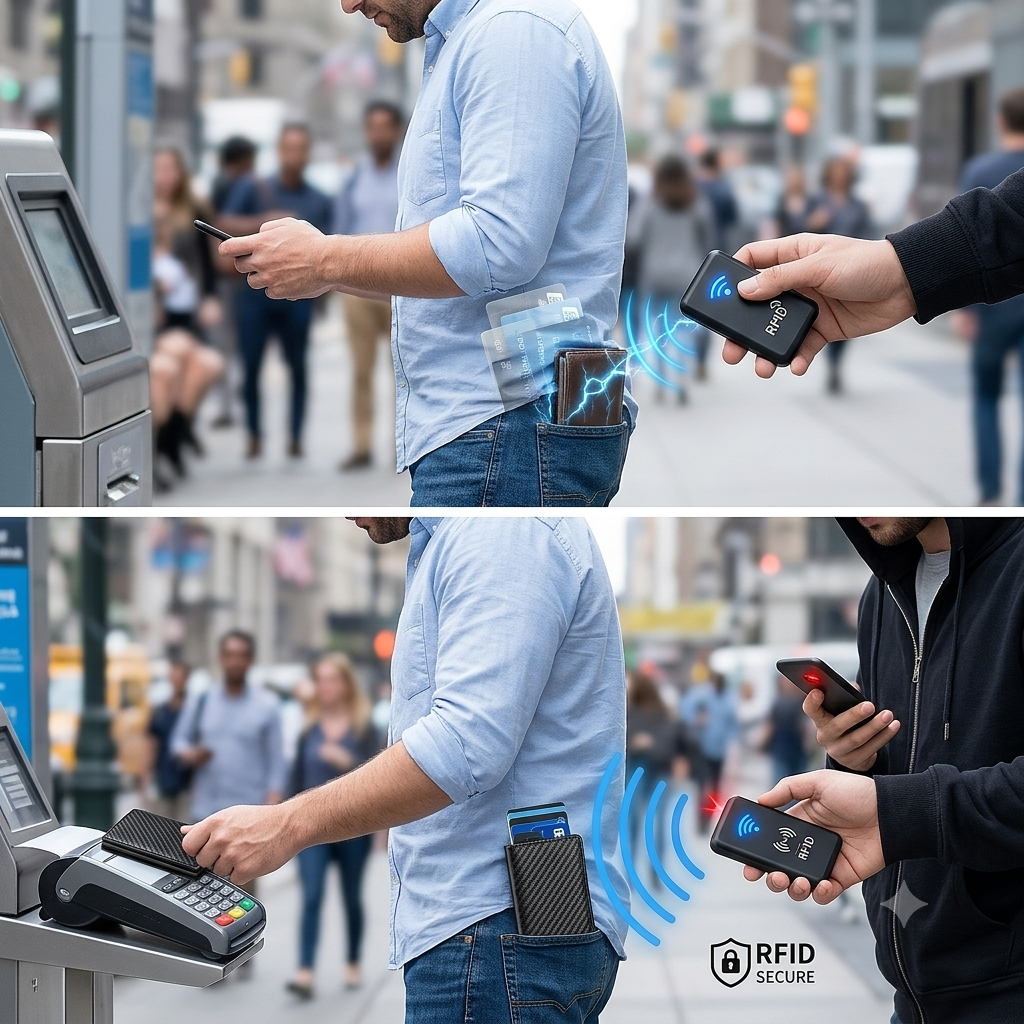
How RFID Skimming Works in Public Spaces
Because these internal antennas are tuned to broadcast openly when excited by a matching radio frequency, a malicious actor operating a portable, high-powered handheld RFID/NFC reading device or even an advanced mobile phone equipped with specific reading software can exploit this communication loop.
By closing the physical distance between their scanning hardware and your clothing pockets, a digital pickpocket can trigger an unauthorized wireless handshake. Within fractions of a second, the scanner powers up your passive card, captures the transmission broadcast, and extracts vital unencrypted identifiers. This can include your card number, expiration dates, and localized transaction tracking codes all without making physical contact, opening your pocket, or taking your physical belongings.
Primary Areas of Vulnerability
Wireless data skimming relies strictly on proximity. Rogue readers have a short operational range, meaning information cannot be intercepted across a street or a large room. Instead, digital pickpockets focus heavily on crowded environments where close proximity is natural and individuals are easily distracted:
1. Transit Gateways & Congested Commutes: Standing packed into public transport platforms or commuter train cars creates perfect close-proximity opportunities for quick, undetected scans.
2. Travel Checkpoints & Airports: Slow-moving, heavily crowded spaces like queuing areas or baggage claim hubs leave travelers highly exposed.
3. Social Venues, Concerts, & Markets: Dense crowds provide perfect covers for physical bumps and proximity approaches.
4. Lines and Cafes: Standing in tight configurations waiting for service gives a scanner an ample window to get within range.
The Practical Solution: How RFID-Blocking Materials Work
Protecting your data doesn't mean giving up the speed and convenience of tap-to-pay. It just takes a little bit of smart physics.
To keep a rogue scanner from reading your cards, you have to block its wireless signal before it ever touches your card's internal antenna. Our secure minimalist RFID wallets do exactly that by using a built-in, ultra-thin aviation alloy frame that creates a protective "shielding cage" around your cards.
This advanced defense system guards your data in three simple steps:
-
1. The Scan Attempt: A digital pickpocket passes by and tries to target your pocket with a close-range wireless scanner. This radio signal easily passes right through regular air and clothing fabric.
-
2. The Shield Interaction: The moment those radio waves hit your wallet, our outer layers of carbon fiber and aviation-grade metal stop them dead in their tracks. The metal safely absorbs and spreads the electrical charge across the outside of the wallet, completely neutralizing the signal.
-
3. Total Data Isolation: Because the signal is completely blocked, zero wireless energy enters the inside of your wallet. Your card chips remain completely asleep, keeping your private information 100% invisible to the scanner.
When you're ready to pay, you simply use the quick-access slider to pop your card out, tap it at the register, and slide it back into its full electromagnetic armor!
Maximizing Everyday Carry Efficiency and Defense
Traditional bifolds made purely from leather or canvas offer no resistance to radio frequencies; electromagnetic waves pass through them as effortlessly as clear glass. Furthermore, bulky traditional designs encourage carrying unnecessary clutter, making it easier to misplace important items.
Upgrading to a secure minimalist wallet solves both vulnerabilities at once. With an ultra-slim 1.5cm profile, our carbon fiber architecture holds up to 6 cards inside its reinforced metal shield, alongside dedicated slots for identification and currency. By moving your daily essentials into an intentionally sleek, front-pocket configuration, you drastically reduce the risk of physical pocket-picking while enjoying passive, military-grade protection against wireless threats.
Take Control of Modern Personal Security
Explore our lineup of carbon fiber and aviation metal minimalist wallets. Shield your data,
streamline your daily carry and move through the world with absolute confidence.